
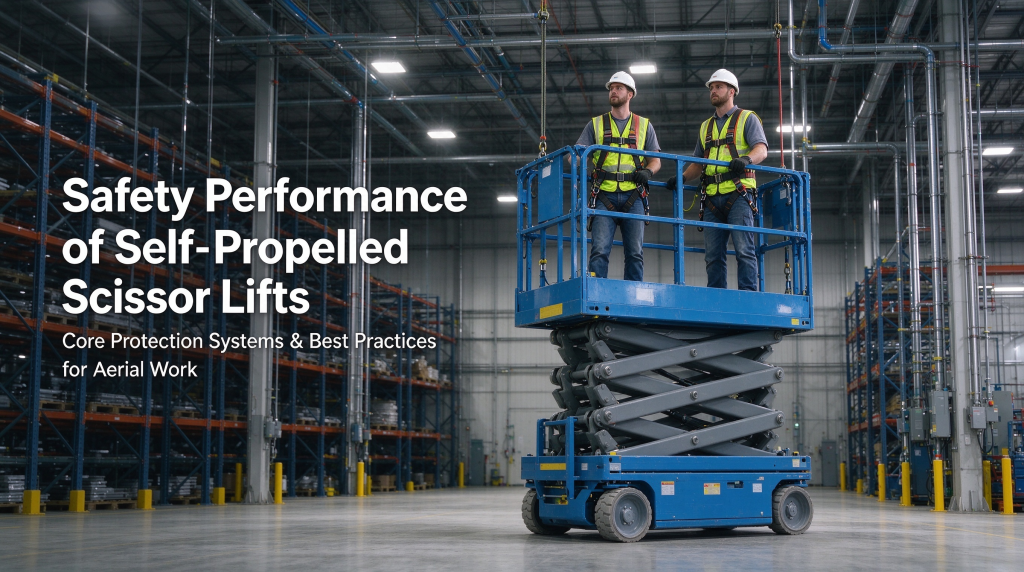
Working at height always carries inherent risks for construction, warehouse maintenance, commercial building renovation and facility inspection. Compared with traditional ladders and scaffolding, self-propelled scissor lifts have become the mainstream aerial work solution largely because of their comprehensive multi-layer safety performance. Modern self-propelled scissor lifts are designed with integrated mechanical, hydraulic, electrical and intelligent monitoring safety systems, complying with global standards such as EN280 and ANSI A92.20. These safety features continuously protect operators and prevent tipping, falling, sudden platform dropping and overload incidents.
In this guide, we break down the core safety performance of self-propelled scissor lifts, explain how each protection system works, share common site hazards, operator safety specifications and routine maintenance practices to preserve long-term safety performance.
Multi-Layer Built-In Safety Protection Systems of Self-Propelled Scissor Lifts
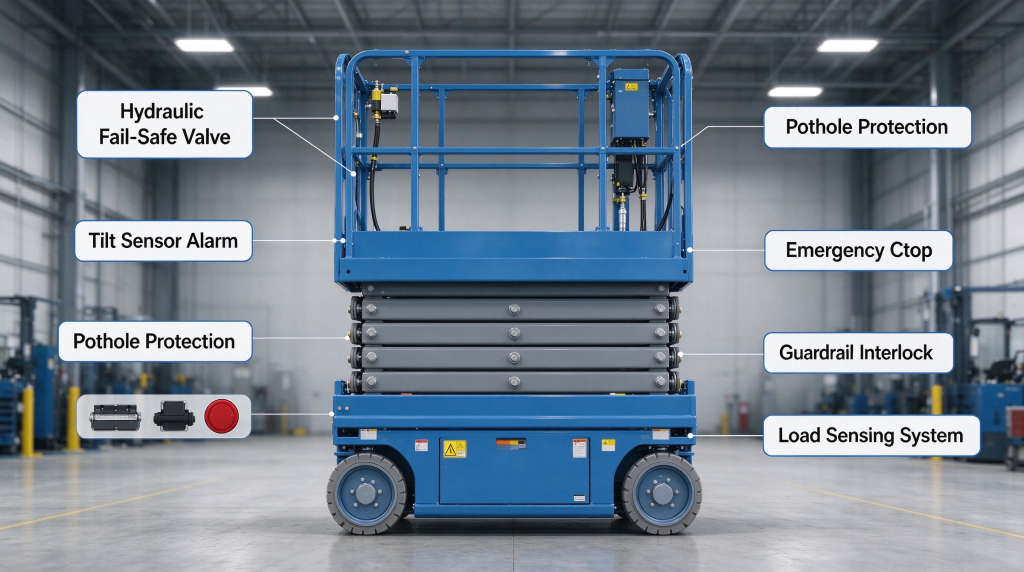
The safety performance of scissor lifts starts from factory design. Every protection module works independently and cooperates as a whole, forming multiple safety barriers rather than relying on a single safety part.
Hydraulic Fail-Safe Protection, Prevent Sudden Platform Descent
The hydraulic system is the power core of lifting movement, and also equipped with critical safety valves.
- Hydraulic burst valve / anti-falling valve: If hydraulic pipelines crack or leak oil accidentally, the valve locks the hydraulic cylinder instantly to avoid uncontrolled rapid falling of the platform.
- Overload pressure relief valve: When the weight on the platform exceeds the rated load, the relief valve automatically cuts off lifting power and triggers audio-visual alarm. The platform cannot rise until extra load is removed.
- Manual emergency lowering valve: In case of power failure or electrical fault, operators or ground staff can manually operate this valve to slowly lower the platform safely to ground level. No power supply required for emergency rescue.
Tilt Angle Protection & Pothole Guard Anti-Tip System
Tipping is one of the most frequent severe accidents for aerial work platforms. Modern self-propelled scissor lifts adopt dual anti-tip safety design.
- Tilt sensor alarm system: Built-in angle monitor detects chassis inclination in real time. Once the tilt angle exceeds the safe threshold, audible and visual alarms activate immediately. At this status, lifting function is locked, only platform descending is allowed. Operators must lower the platform and reposition the machine on flat solid ground before continuing work.
- Pothole protection guards: Automatically deploy when the platform lifts up. If the machine drives over pits, gaps or uneven ground, pothole guards support the chassis and stop wheel sinking, effectively preventing rollover accidents on warehouse or construction floors. When the platform is fully lowered, guards retract automatically for normal travel.
Emergency Stop & Dual Control Safety
Red emergency stop buttons are installed both on platform control box and ground control panel. Pressing E-STOP cuts all power and hydraulic movement instantly to halt all machine actions in emergency situations. The dual-control design also enables ground staff to intervene when operators on the platform cannot operate normally. The control system has interlock logic to avoid conflicting commands from upper and lower control panels.
Fall Prevention: Guardrail & Anti-Slip Platform Structure
The enclosed safety guardrail system is the basic fall protection barrier. Standard guardrails include top rail, middle rail and toe board, manufactured following international height requirements. The safety gate has interlock switch: if the gate is open, the machine will refuse lifting operation. The platform surface uses anti-slip patterned steel plate to reduce slip risk when the floor is wet or dusty. Anchor points are reserved on guardrails for operators to attach safety harness lanyards for extra fall protection.
Intelligent Load Sensing & Real-Time Monitoring
High-end self-propelled scissor lifts are equipped with intelligent load sensors, continuously detecting total weight on the platform (including operators, hand tools and materials). When approaching rated load, pre-warning will pop up. Once overload occurs, the system prohibits lifting movement. This avoids overloading which is the top cause of tipping accidents.
Structural Safety Performance: Scissor Arm & Chassis Stability
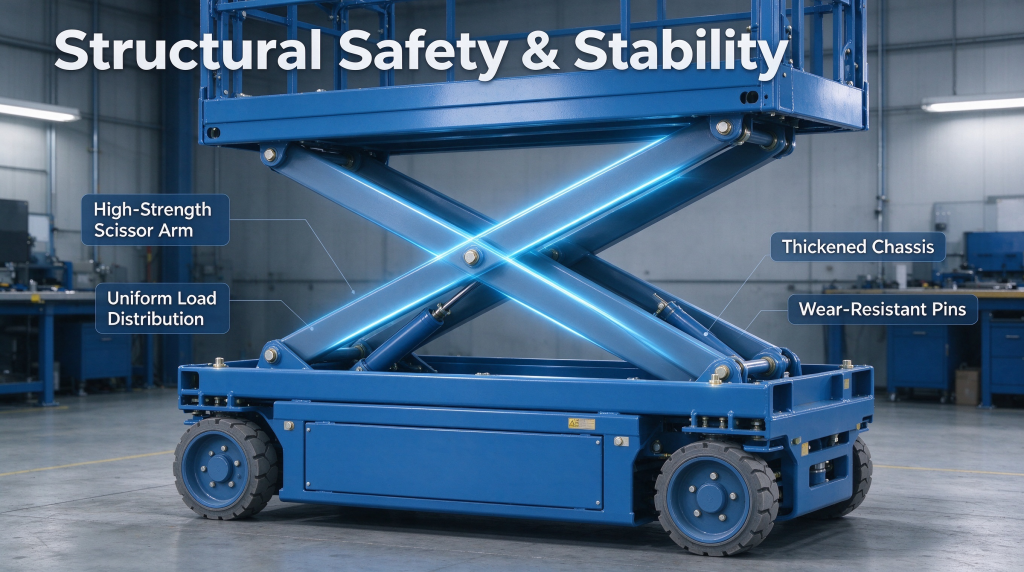
Safety performance cannot be separated from mechanical structural design. The cross X-type scissor arm assembly is manufactured with high-strength alloy steel, through welding and stress relief treatment. It evenly distributes vertical load to the chassis, maintaining stable vertical lifting without horizontal shaking.
Key structural safety features:
- Thickened chassis frame improves the overall weight balance, lowering the center of gravity for better stability.
- Hinge pins of scissor arms use wear-resistant lubrication sleeves to reduce metal fatigue and structural deformation after long working hours.
- The extendable platform deck is reinforced, load capacity keeps consistent even after deck extension.
- All structural components pass factory load test and destructive inspection before delivery.
The structural design ensures that load force transfers uniformly across the whole machine, instead of concentrating on single scissor arm joint. This greatly reduces the risk of structural fracture under normal rated working conditions.
Main Site Hazards That Affect Safety Performance of Scissor Lifts
Even with complete factory safety configurations, improper site conditions and wrong operations will weaken safety performance and trigger risks. Understanding these hazards helps site managers make full use of the machine’s safety protection capabilities.
- Overload and uneven load distribution Many operators mistakenly calculate load only by personnel weight and ignore tools and spare parts. Concentrating heavy items on platform edges shifts center of gravity and increases tipping risk, even within nominal load limit. Load must spread evenly across platform deck.
- Working on sloped, soft or hollow ground Scissor lifts are designed to work on firm, flat solid ground. Grass, mud, thin floor and slopes beyond machine’s rated angle will defeat tilt protection and pothole guard functions.
- High wind operation for outdoor models Wind force creates lateral pushing load on the elevated platform. Every machine has clear wind speed limit. Working above rated wind speed will exceed structural safety margin and cause instability.
- Collision and overhead crushing risk Moving the elevated platform near beams, pipes and ceiling structures may trap operators. Operators must keep observing overhead obstacles when lifting or traveling.
- Damaged safety devices from unauthorized modification Removing pothole guards, disabling tilt alarms or cutting off emergency stop interlocks directly destroys the layered safety system, and voids equipment certification.
Operator Operation Standards to Maximize Safety Performance
Machine safety systems serve as protection barriers, but standardized operation is the core guarantee for safe aerial work.
- Mandatory pre-shift inspection before every use Before starting work each day, operators must complete visual and functional check:
- Check scissor arms for cracks, deformation and oil leakage
- Inspect tires, wheels and pothole guards
- Test emergency stop button and manual emergency lowering valve
- Verify tilt alarm and overload warning function
- Check guardrails and safety gate integrity
- Confirm battery power and control panel response Do not start operation if any fault or damage is found.
- Rules during aerial work
- Stand only on platform floor; never climb on guardrails, boxes or stacks to gain extra height.
- Keep whole body inside guardrail boundary; avoid overreaching outward.
- Wear full-body safety harness and attach lanyard to designated anchor points.
- Do not allow personnel or materials to hang outside the platform.
- When traveling with platform elevated, move slowly and watch ground and overhead obstacles.
- Emergency response training All operators should receive training on emergency procedures: what to do when tilt alarm triggers, power loss, platform stuck, or hydraulic failure. Knowing how to activate manual lowering is essential for rescue scenarios.
Regular Maintenance Preserves Long-Term Safety Performance
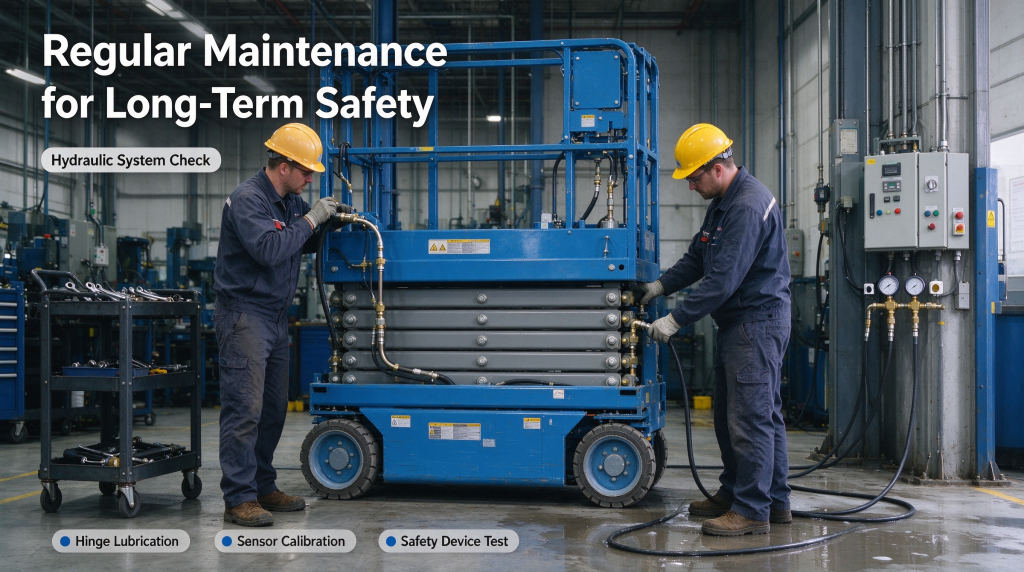
Safety performance will gradually decline without regular maintenance. Safety components require periodic inspection, lubrication and testing.
Daily Check
Check oil leakage, tire damage, emergency stop function, alarm signals and battery condition before each shift.
Monthly Maintenance
- Lubricate all scissor arm hinge pivot points
- Tighten loose bolts on chassis and guardrail
- Inspect hydraulic hoses and sealing rings for aging and cracking
- Clean dust on sensors and control panel
Quarterly & Annual Safety Inspection
- Replace hydraulic oil and filter according to working hour schedule
- Full inspection of electrical wiring, controllers and sensors
- Calibrate tilt angle sensor and overload load sensing system
- Complete functional test of all safety protection devices
- Certified technician performs annual safety assessment and load test
Worn seals, aging cables and dry hinge pins will slowly reduce safety response speed. Preventive maintenance keeps all safety systems working as designed.
Frequently Asked Questions About Scissor Lift Safety Performance
Q1: Can tilt protection completely prevent tipping accidents?
A: Tilt protection is an active safety warning and locking system, it can greatly reduce tipping risk. But it cannot offset extremely unsafe operation such as severe overload, working on steep slope or strong wind. It is the last warning line instead of absolute protection.
Q2: What is the difference between indoor and outdoor scissor lift safety design?
A: Indoor models focus on non-marking tires and pothole protection for smooth floors, lower wind resistance requirement. Rough terrain outdoor scissor lifts add stabilizers, stronger chassis and higher wind resistance rating for uneven construction sites.
Q3: Are guardrails enough for fall protection?
A: The enclosed guardrail system is primary fall protection. For high-risk projects, operators still need to use full body harness connected to the platform anchor point as secondary protection, meeting OSHA and IPAF safety requirements.
Q4: Will safety devices stop working after years of usage?
A: Not if maintained properly. With regular inspection and part replacement, safety valves, sensors and emergency systems can maintain stable performance over the machine’s service life. Lack of maintenance is the main cause of safety system failure.
Conclusion
The outstanding safety performance of self-propelled scissor lifts comes from layered engineering design: hydraulic fail-safe valves, anti-tip tilt sensors, pothole protection, emergency stop system, solid guardrail enclosure and intelligent load monitoring. All these safety modules work together to reduce risks for high-altitude operators.
However, equipment safety systems can only play their full value when combined with trained operators, proper site assessment and scheduled maintenance. For industrial and commercial projects requiring long-term aerial work, selecting scissor lifts with complete certified safety configurations is the key investment to protect workers and avoid costly site accidents.
If you are looking for self-propelled scissor lifts with reliable full-set safety protection for your aerial projects, contact our team to get detailed safety specification documents and product quotations.